
The camper itself was ready — insulated, mattressed, jacks at hand, dehumidifier humming year-round. This article picks up the story with everything we built inside the camper to make it a true four-season basecamp: a custom third bed in the truck bed, a wall panel that turns one interior wall into a workstation, a Bluetti power system that runs everything from the fridge to the laptop, two solar panels on the roof, a custom electrical setup with one of the cleverest backup tricks in overlanding, an ARB fridge on a slide, and a tie-down system that keeps it all from moving an inch on a washboard road.
📑 Table of Contents (click to collapse)
- Key Takeaways
- The Third Bed: Custom Plywood Platform
- The Wall Panel: One Wall, Many Functions
- Power: Bluetti AC200L + B300
- Solar: Two Roof-Mounted Overland Solar 160 W ETFE Panels
- Custom Electrical Work
- The Backup: Recharge from the Tacoma's Stock Bed Inverter
- ARB Elements Fridge & Slide
- L-Track Tie-Downs: Nothing Slides on Rough Roads
- Truck-Bed Protection & Security
- Custom Covers, Bags, and Containers (Coming Up)
-
Frequently Asked Questions
- Can the Bluetti really accept "dirty sine wave" power from the Tacoma's stock bed outlet?
- How long can you run the ARB fridge from the Bluetti without solar?
- Why use rivet nuts in the truck bed instead of bolting through?
- Is the wall panel really reversible to the other side?
- How do you keep ActionPackers and the chuck box from sliding around on rough roads?
- Did you do the electrical work yourself?
- What's your backup if the Bluetti dies in the backcountry?
- Photo Gallery: The Full Build
- What's Next: The Outdoor Setup
Every modification follows the same rule we set for the camper itself: removable, reversible, and not destructive to the truck. The build can be undone in an afternoon, and the truck can return to bone stock if needed.
Key Takeaways
- A custom 3/4″ plywood third-bed platform sits at perfect height in the truck bed — sleeps a third person, stores gear when not in use, and removes completely
- The interior wall panel mounts to the FWC L-tracks and carries a monitor arm, iPad mount, ceiling-fan remote, cellular router, two AC outlets, and two USB-A ports — and it’s reversible to the opposite wall
- A Bluetti AC200L + B300 stack delivers 5,120 Wh of clean lithium power running every AC and DC need in the camper
- Two roof-mounted Overland Solar 160 W ETFE panels keep the system topped up indefinitely in good sun
- A backup recharge cable plugs the Bluetti into the Tacoma’s stock 400 W bed-mounted AC outlet — the Bluetti is one of the few power stations that accepts the truck’s “dirty” sine-wave output, turning the truck’s engine into a backup generator
- The ARB Elements 63 qt fridge sits on a matching slide for one-handed access
- L-track tie-downs lock ActionPackers and the chuck box so nothing slides on rough roads
- McMaster-Carr rivet nuts in the truck bed are the only permanent change to the truck — and they’re invisible
The Third Bed: Custom Plywood Platform
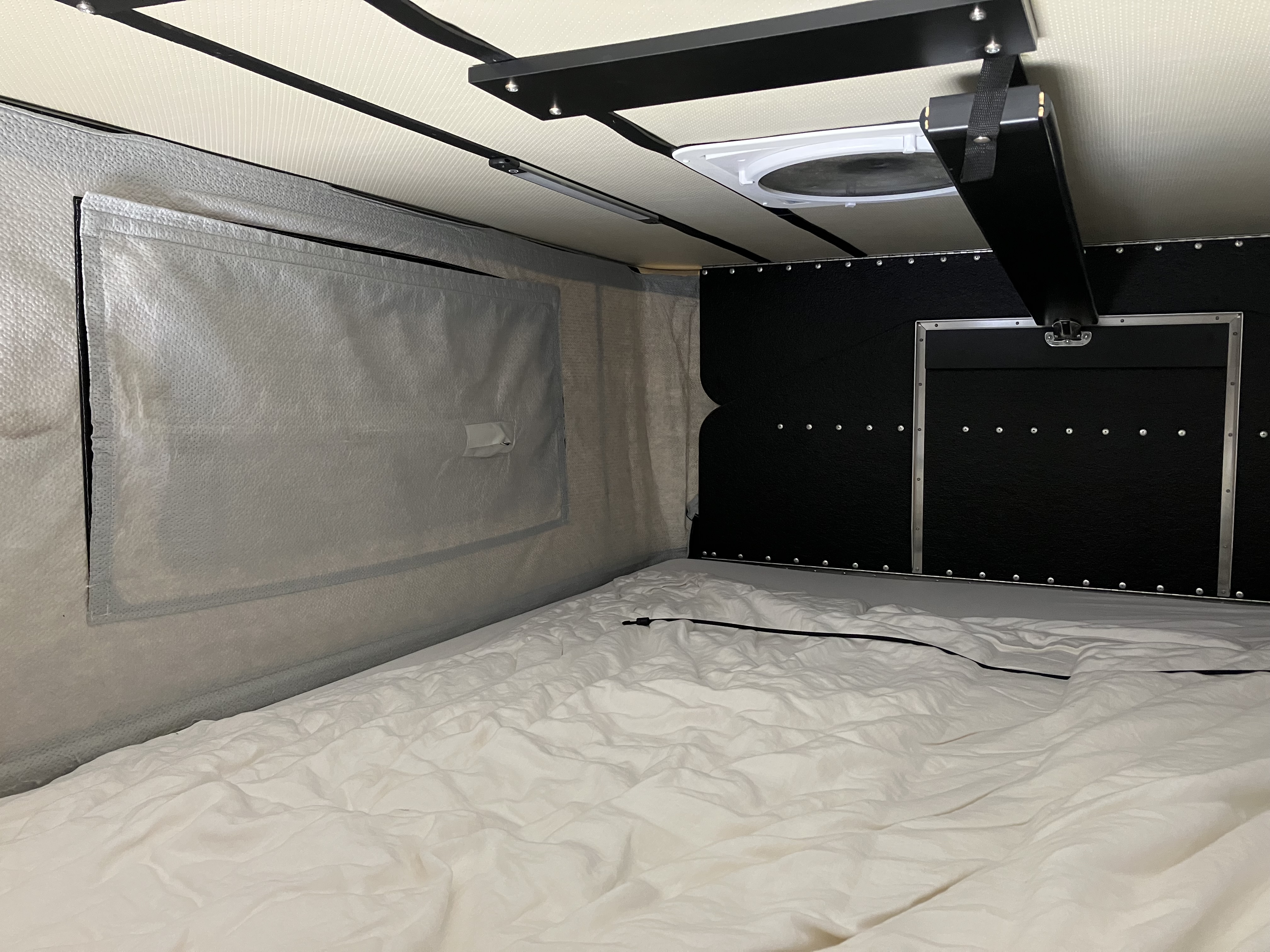
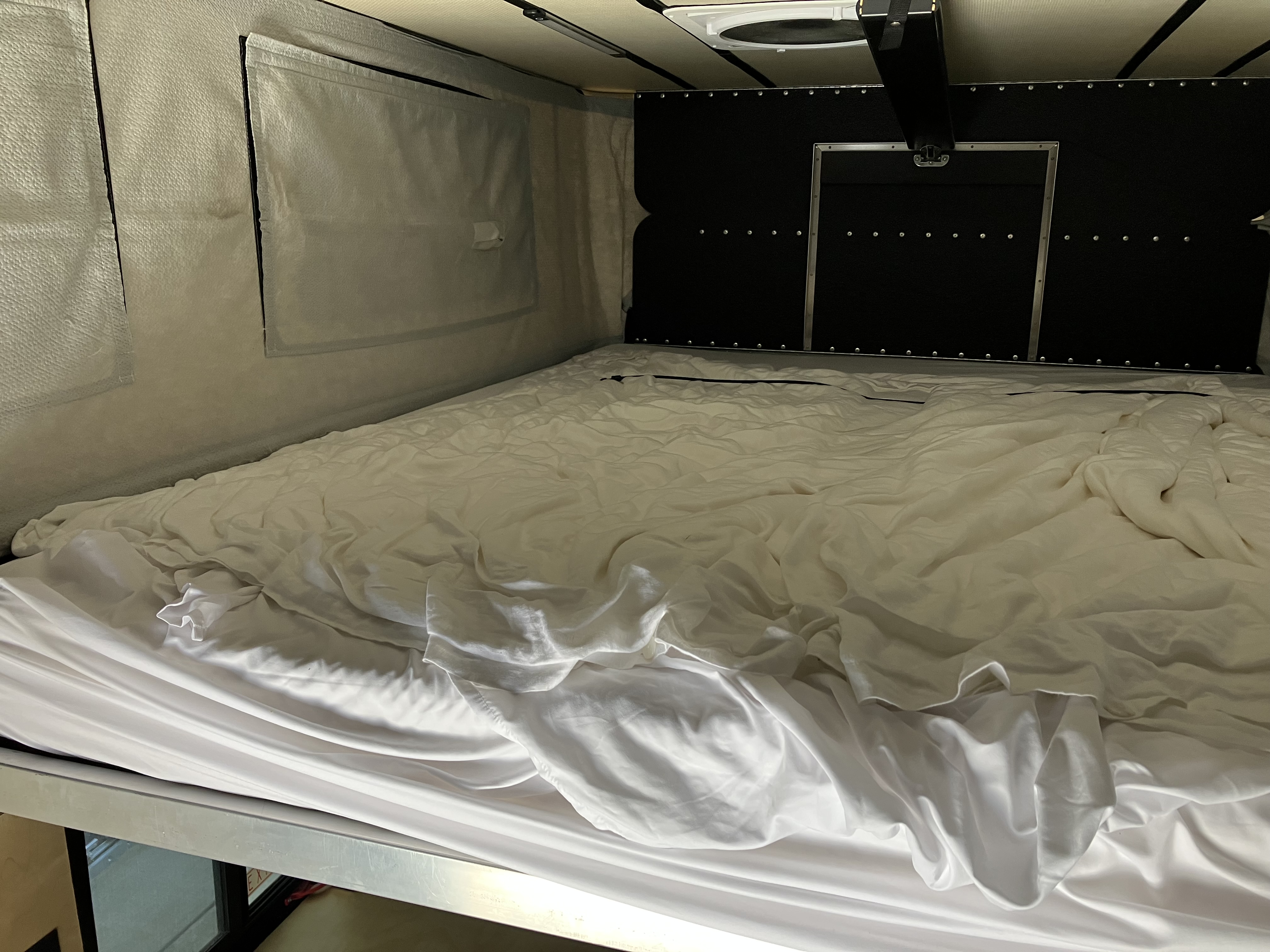
The Project M’s standard dinette converts to a bed and the upper area sleeps two, but adding a third sleeping space required custom work. The solution: a removable platform built from 3/4″ plywood that sits in the truck bed at exactly the right height to serve as a proper mattress foundation.
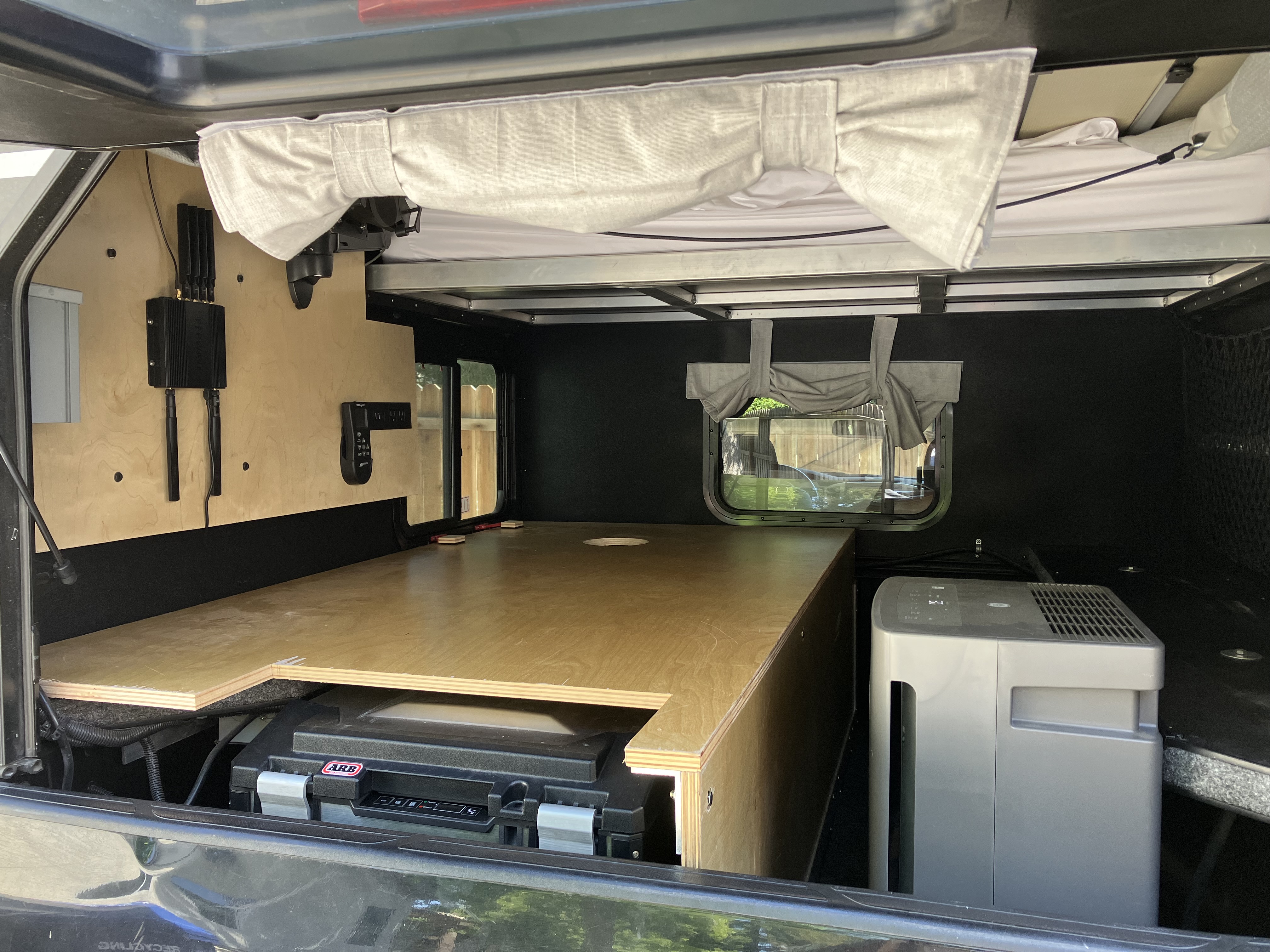
The platform mounts to the truck bed using rivet nuts from McMaster-Carr — specifically the variants rated for composite truck-bed materials, which grip without the stress concentrations that crack fiberglass around traditional bolts. When the platform is removed, only small threaded inserts remain, virtually invisible and with zero effect on the truck’s normal use or resale value. The same rivet-nut system is used for the ARB fridge slide and several other build components, so the entire interior shares one removable mounting standard.
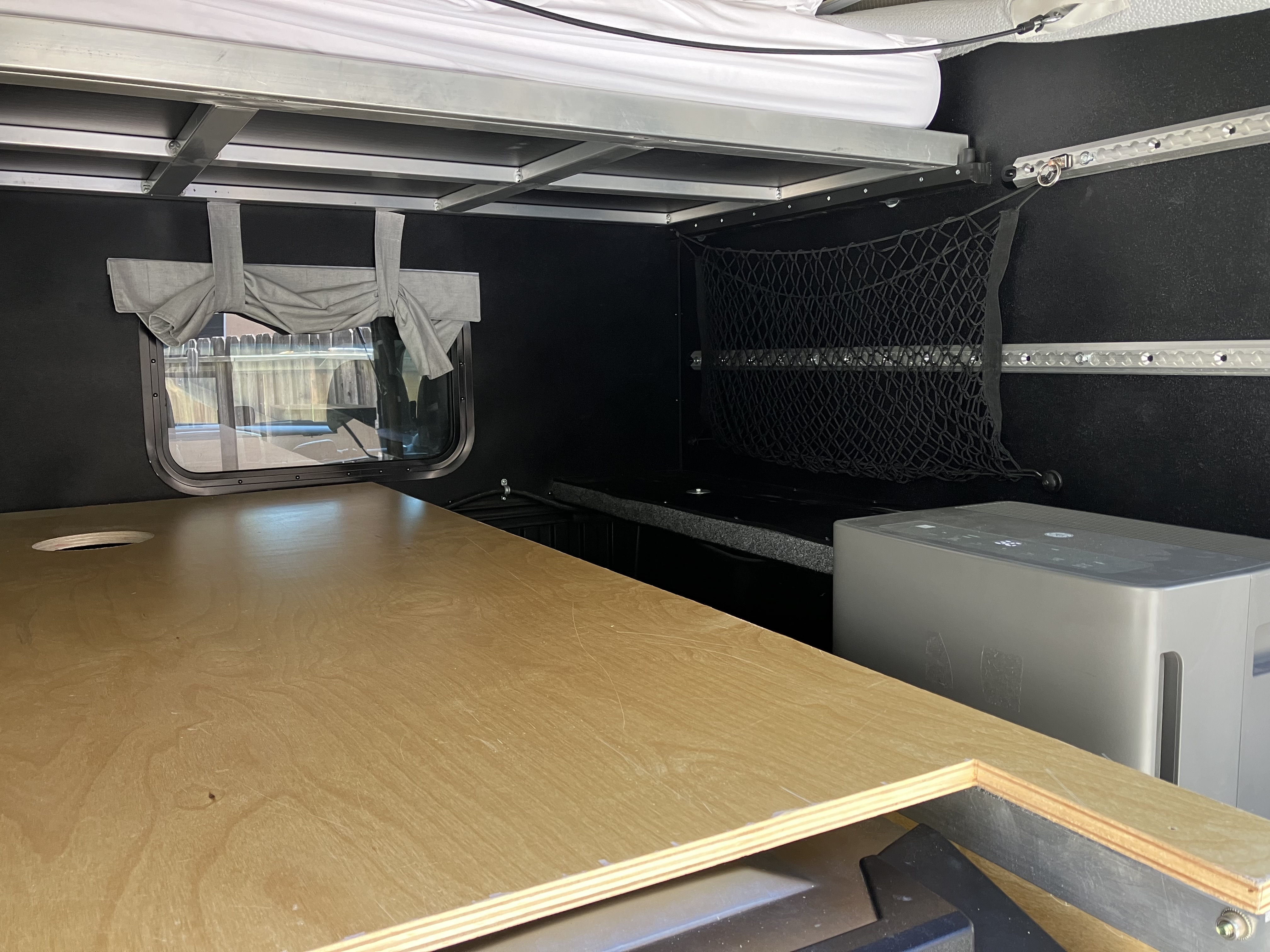
When the third bed isn’t in sleeping mode, the platform doubles as gear storage and a stable base for ActionPackers and the chuck box. It removes in under five minutes if the truck needs to do truck work.
The Wall Panel: One Wall, Many Functions
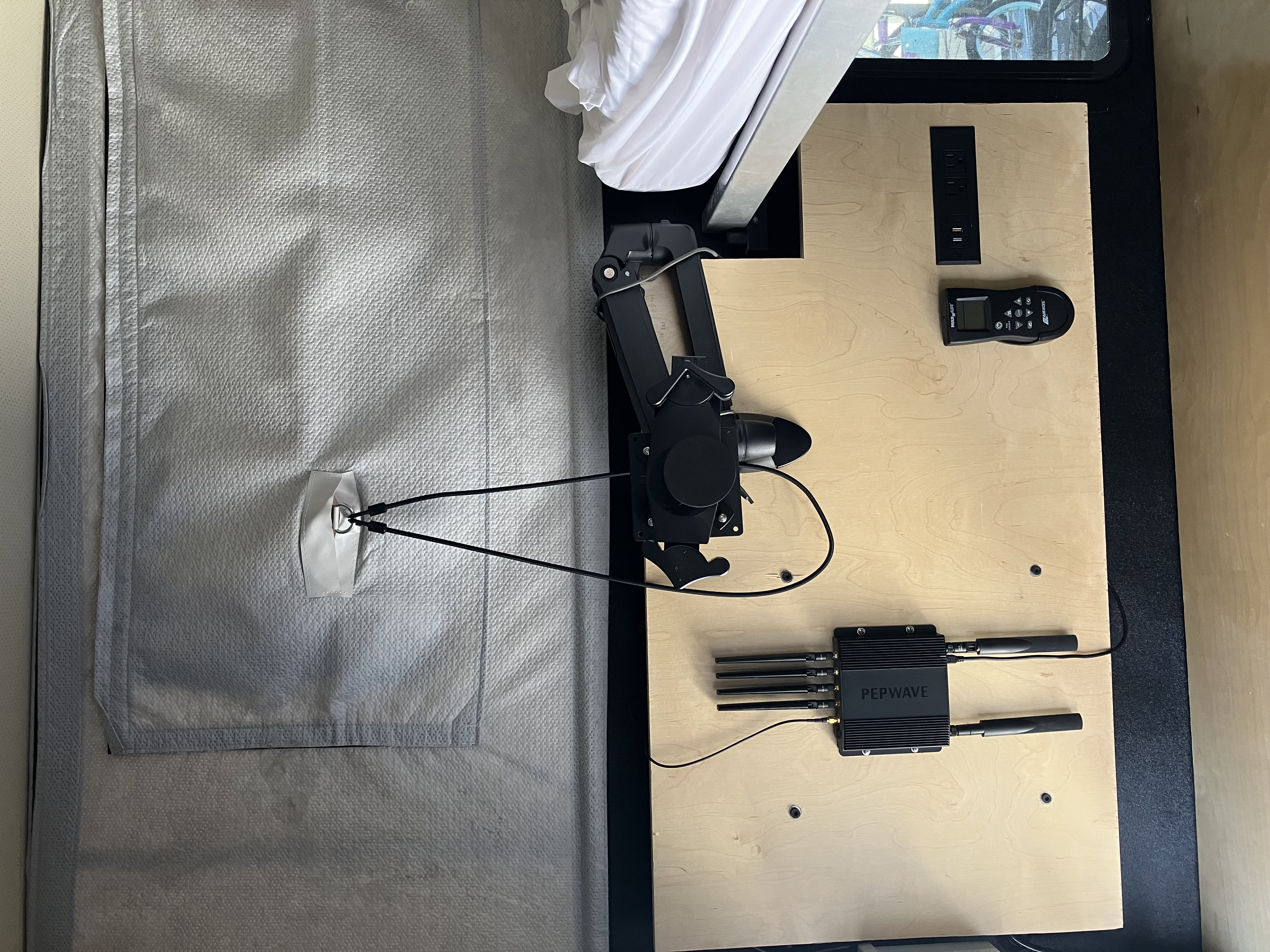
The custom wall panel is one of the most useful pieces of the entire interior. It’s a wooden panel that mounts to the FWC L-tracks (covered in the previous article), it carries a stack of practical gear, and — critically — it’s reversible to the opposite wall by sliding it up out of the L-tracks and remounting on the other side, in case the layout ever needs to flip.
Monitor Arm
An Ergotron 45-243 monitor arm bolts to the panel and holds a working monitor at eye level when I’m parked at a spot with a view and want to work for a while. The arm folds flush against the panel for travel.
iPad Mount
A CTA Digital rotating wall mount holds an iPad — perfect for navigation, music, video, or as a second screen alongside the monitor. The rotating mount lets the iPad swing into landscape or portrait depending on what I’m doing.
Ceiling Fan Remote
A small holder on the panel keeps the FWC ceiling-fan remote in a known place. Sounds trivial; in practice, when you’re half-asleep and the camper is too hot, you don’t want to be hunting for the remote.
Cellular Router: Peplink MAX BR1 Pro
A Peplink MAX BR1 Pro CAT-20 cellular router lives on the panel. It’s a serious mobile router — not a hotspot — and it gives the camper genuine connectivity in places where a phone hotspot would fail. Worth every dollar when work needs to happen from a campsite.
AC Outlets & USB Ports
Two standard 120V AC outlets and two USB-A ports are mounted into the panel and wired into the Bluetti system (more on that below). One AC outlet handles the monitor or a laptop charger, the other is general-purpose. The USB-A ports keep phones, headlamps, and the iPad topped up without needing a charging brick.
Power: Bluetti AC200L + B300
Power management makes or breaks extended off-grid camping. The system is built around a Bluetti AC200L Portable Power Station paired with a B300 Expansion Battery — 2,048 Wh + 3,072 Wh = 5,120 Wh of clean lithium power on tap.
The AC200L’s 2,400 W pure sine wave inverter runs any standard appliance — a laptop, a small kettle, a charger, the dehumidifier when the camper is parked. The B300 expansion stacks on top and roughly doubles the runtime. Both units sit in storage compartments without any permanent mounting; they lift out for charging at home or for use elsewhere.
This combination easily powers the ARB fridge alone for more than ten days without solar input, assuming the fridge cycles normally in moderate temperatures. With the fridge plus modest device charging, expect a week-plus. With solar topping up daily, the system runs indefinitely.
Solar: Two Roof-Mounted Overland Solar 160 W ETFE Panels
Two Overland Solar Overlander 160 ETFE semi-flexible panels sit on the FWC roof rails (specified at the factory — see the previous article). The ETFE coating resists UV degradation far better than the standard plastic films, and the semi-flexible construction lets the panels conform slightly to the roof’s gentle curve, improving aerodynamics versus rigid panels mounted on standoffs.
Two 160 W panels deliver up to 320 W peak — more than enough to keep the Bluetti charged while running the fridge continuously and powering everything else for evening use. Even partial shade from trees doesn’t crash the system; the ETFE panels maintain reasonable output in conditions that would shut down older technology completely.
Custom Electrical Work
All of this — the AC outlets in the wall panel, the USB ports, the Peplink router, the ceiling fan, the rear flood lights, and the Bluetti as the central battery — is wired together by a licensed electrician. Every AC and DC need in the camper runs through the Bluetti. There’s no separate “house battery” or DC fuse panel to maintain; the Bluetti is the brain, and it’s always plugged in to keep everything topped up.
The system is designed so the Bluetti can be unplugged, lifted out, and used as a portable power station without breaking anything else. Plug it back in, and the camper is fully powered again.
The Backup: Recharge from the Tacoma’s Stock Bed Inverter
This is one of the most genuinely clever pieces of the entire build. Tucked under the right-side dinette seat is a standard AC power cable. One end is wired into the Bluetti’s AC input. The other end has a normal 120 V household plug — and it’s just long enough to reach the stock 400 W AC outlet in the bed of the Tacoma.
Pop the cable out from under the seat, plug it into the Tacoma’s bed outlet, start the truck, and the engine’s alternator now charges the Bluetti through the stock factory inverter. The Tacoma’s gas tank effectively becomes a backup generator.
Why this is a big deal: Bluetti accepts the Tacoma’s “dirty” sine wave
Toyota’s stock 400 W AC bed outlet is a budget inverter — it produces a modified (or “dirty”) sine wave, not the clean pure-sine-wave AC that most premium electronics expect. Sensitive electronics often refuse to charge from dirty AC, and many higher-end power stations protect themselves by rejecting that input outright.
Bluetti’s AC200L has an advanced setting that explicitly accepts modified-sine-wave input. I’ve tested it: plug into the Tacoma, start the engine, and the Bluetti charges normally. This is one of the rare power stations that does this. It turns the entire truck — the gas tank, the alternator, the engine — into a backup generator with no extra hardware. On a foggy week with weak solar, that’s the safety net.
ARB Elements Fridge & Slide
Refrigeration separates serious overlanders from weekend warriors. The ARB 63 qt Elements Fridge Freezer provides the capacity needed for extended trips without the bulk of larger units — a week’s worth of food for three people, fitting perfectly in the Project M’s limited space.
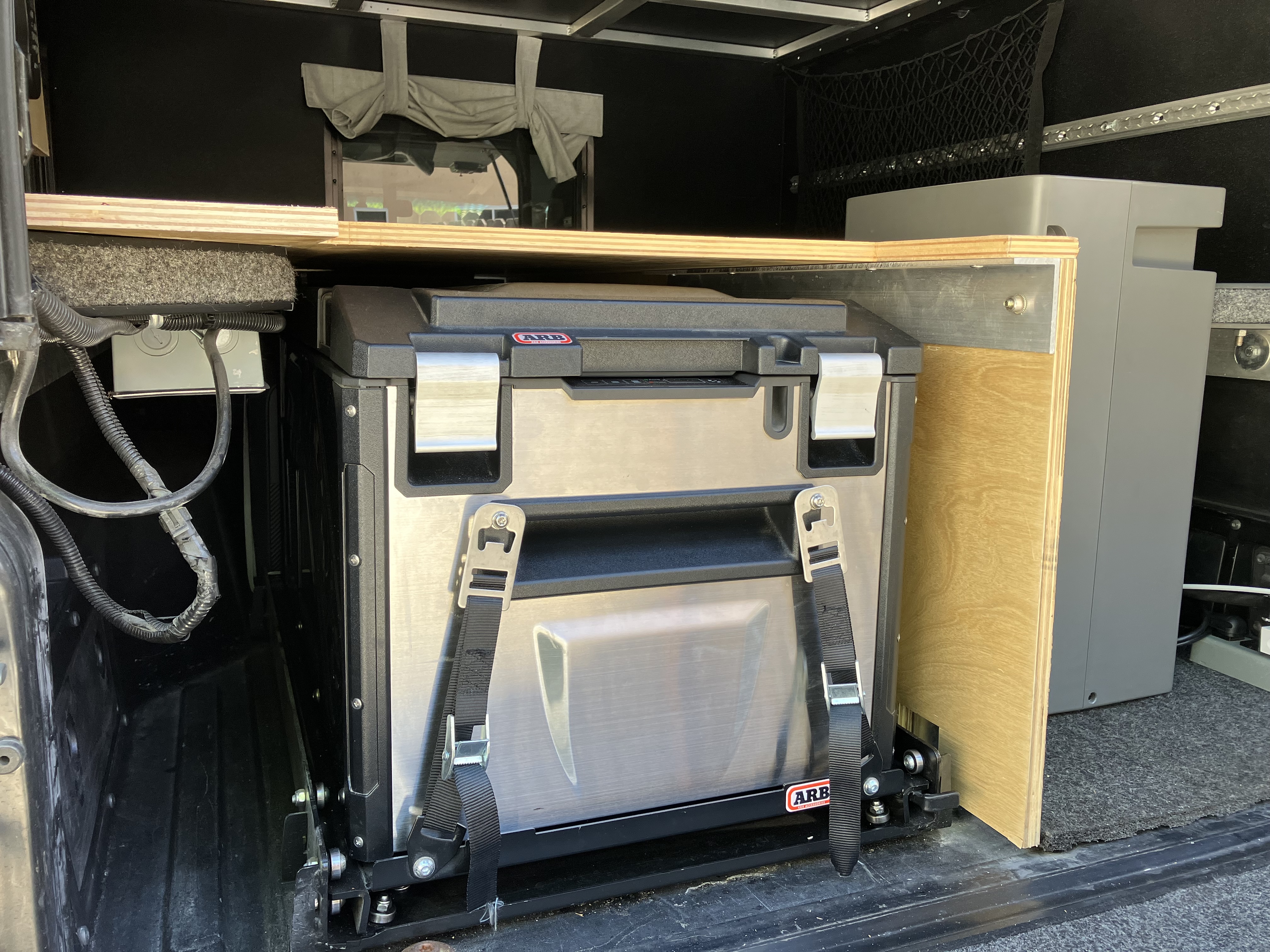
The matching ARB Elements Fridge Slide transforms access completely. Instead of reaching over the fridge to grab items from the back, everything slides out smoothly on heavy-duty rails rated for the fridge’s 60-pound loaded weight. The slide mounts to the same rivet-nut system used throughout this build, maintaining the removable theme.
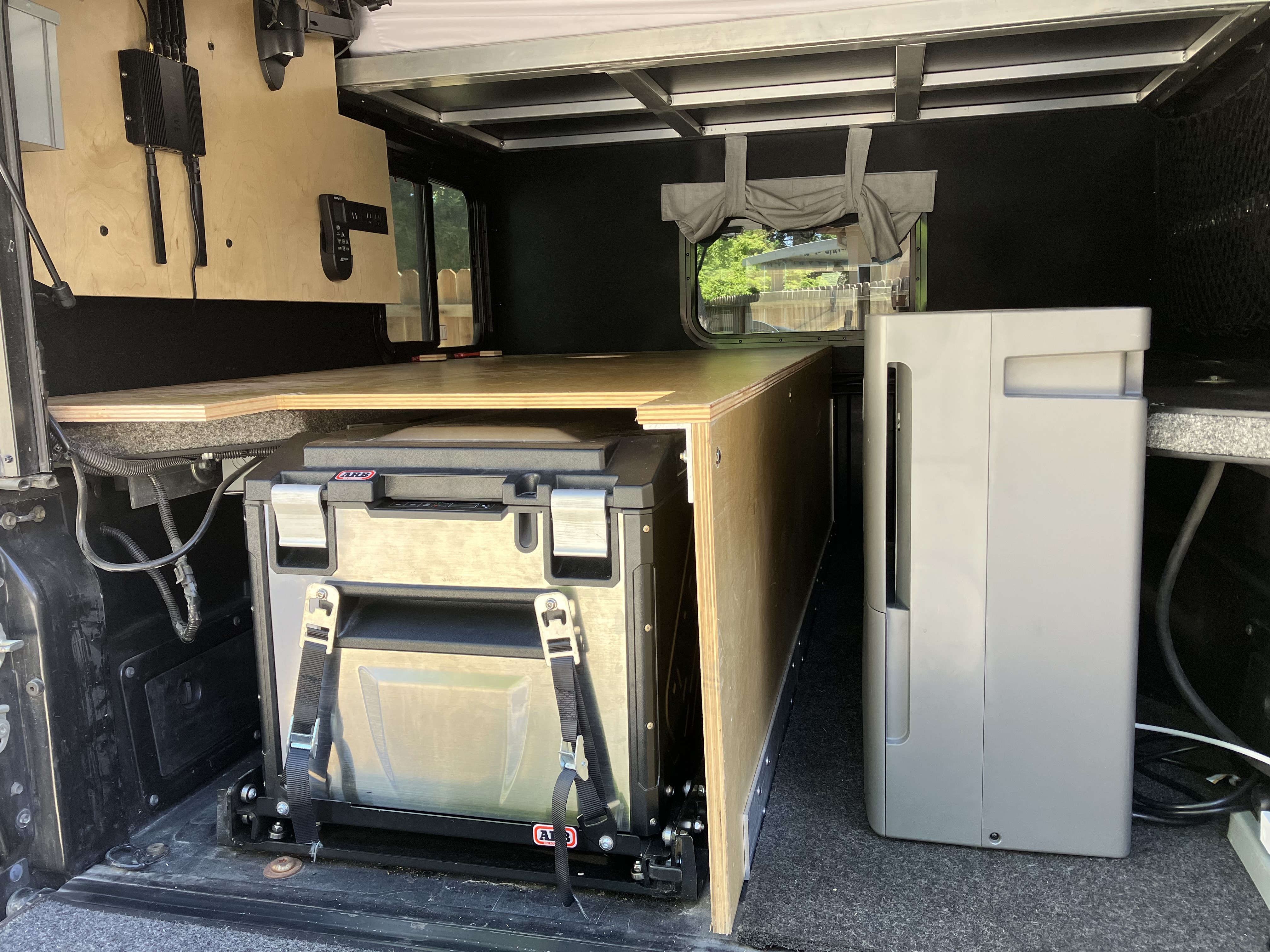
The fridge draws roughly 45 W when actively cooling and averages about 13–20 W over a full duty cycle. Manageable for the Bluetti to run for well over a week without solar — and indefinitely with even modest sun.
L-Track Tie-Downs: Nothing Slides on Rough Roads
The interior L-tracks (specified at the factory) earn their keep on every drive. Heavy gear lives in Rubbermaid ActionPackers and a Trail Kitchens chuck box, and ratchet straps anchor each one to the L-tracks before any drive. Combined with thoughtful organization, nothing slides, nothing rattles, and nothing ends up across the camper after a washboard road.
Truck-Bed Protection & Security
A few small additions to the truck bed itself make the build live longer and travel safer. None of them is glamorous; all of them solve a real problem.
- BedRug under the platform — A BedRug carpet covers the entire truck bed underneath the third-bed platform, the fridge slide, and any loose gear. It quiets road noise, prevents the painted bed liner from getting scratched by gear, and is far more comfortable to kneel on when working in the bed.
- Tailgate mat — A heavy rubber tailgate mat protects the inside of the tailgate from gear scrapes and gives sliding boxes a non-slip surface when loading and unloading.
- Tailgate lock — A simple factory-style tailgate lock stops anyone from dropping the tailgate and grabbing whatever’s in the bed.
- Rok Block — The Rok Block is a small wedge that slips between the tailgate and the bed — it stops the tailgate from rattling on washboard roads, which is a sound that can drive you insane on a long forest service drive.
Custom Covers, Bags, and Containers (Coming Up)
One last theme worth flagging here, even though the details belong in subsequent articles: every piece of major gear in this build has a custom-made cover, bag, or case to protect it (and the camper) during travel. Hammock, hammock stand, sun shield, sun-shield stakes, table lighting rod, the collapsible trash can — each gets its own purpose-built fabric container, all sewn by Beowulf Sewing. It’s a level of polish that’s slightly obsessive and absolutely worth it; nothing scratches anything, and packing/unpacking goes faster because every item has a known home.
Coming articles will get into each piece of outdoor gear and the bag that protects it.
Frequently Asked Questions
Can the Bluetti really accept “dirty sine wave” power from the Tacoma’s stock bed outlet?
Yes. The Bluetti AC200L has an advanced setting that explicitly enables modified-sine-wave AC input. I’ve tested it on the Tacoma’s stock 400 W bed outlet and the Bluetti charges normally. Most premium power stations either refuse the dirty sine wave outright or risk damage; Bluetti is one of the rare ones that handles it. That’s what makes the truck-engine backup recharge possible without adding any extra hardware.
How long can you run the ARB fridge from the Bluetti without solar?
Conservatively, well over a week running just the fridge — easily 10+ days at typical duty cycles in moderate temperatures. The math: ARB Elements 63 qt averages roughly 13–20 W in real-world cycling, the AC200L + B300 holds 5,120 Wh, so 5,120 ÷ 17 ≈ 300 hours, or about 12 days. Once the fridge reaches temperature and is full of cold mass, draw drops further.
Why use rivet nuts in the truck bed instead of bolting through?
Rivet nuts are how you mount things to the truck bed without permanent damage. They allow everything (third-bed platform, fridge slide, anything else) to be unbolted and removed cleanly — small threaded inserts remain, virtually invisible, and the truck returns to stock with no warranty implications, no resale hit, and no holes to patch. McMaster-Carr’s composite-rated rivet nuts grip the bed material without the stress concentrations that crack fiberglass around traditional through-bolts.
Is the wall panel really reversible to the other side?
Yes. Because the panel mounts to the FWC L-tracks (which run on both interior walls), it slides up and out of one wall’s tracks and drops into the other side. Practically, the AC and USB outlets are wired to a fixed location and require a re-cable, but the panel itself and everything bolted to it can move. Good for adapting the layout for a different trip configuration or a passenger.
How do you keep ActionPackers and the chuck box from sliding around on rough roads?
Ratchet straps anchored to the FWC L-tracks lock everything down. The L-tracks run the length of both interior walls, so any heavy item — ActionPackers, the Trail Kitchens chuck box, or anything else loaded for a trip — gets strapped directly to the camper structure. Combined with thoughtful packing (heavy low, light high, nothing loose), nothing slides on washboard roads.
Did you do the electrical work yourself?
No. The custom AC and DC wiring, the AC outlets and USB ports in the wall panel, and the integration of the Bluetti as the central battery were all installed by a licensed electrician. The plywood and mounting work was DIY; the wiring wasn’t.
What’s your backup if the Bluetti dies in the backcountry?
It hasn’t yet — and with the two roof-mounted solar panels and a clean lithium chemistry, it’s hard to imagine it dying for any reason but neglect. If solar is weak (a long foggy week, bad weather), the backup is the truck itself: pull the AC cable from under the right-side dinette seat, plug into the Tacoma’s bed outlet, start the engine, and the alternator + factory inverter recharge the Bluetti directly. Gas in the tank becomes power for the camper.
Photo Gallery: The Full Build
What’s Next: The Outdoor Setup
The truck and the camper are now done — every modification, every decision, every wire and bolt accounted for. What’s left is everything that lives outside the camper: the kitchen, the lighting, the chairs and tables, the shower, the hammock, the kayak, the bikes, and the custom-sewn bags that keep all of it organized in the truck bed. That’s where the philosophy of “sleep inside, live outside” finally pays off — and that’s what the next articles in this series are all about.